

Most cooker hoods can be installed in one of two ways: ducted to the outside of the property, or set up to recirculate filtered air back into the kitchen. Both can work well, but they deal with cooking air differently and the best choice depends on your kitchen layout, installation options and how you cook.
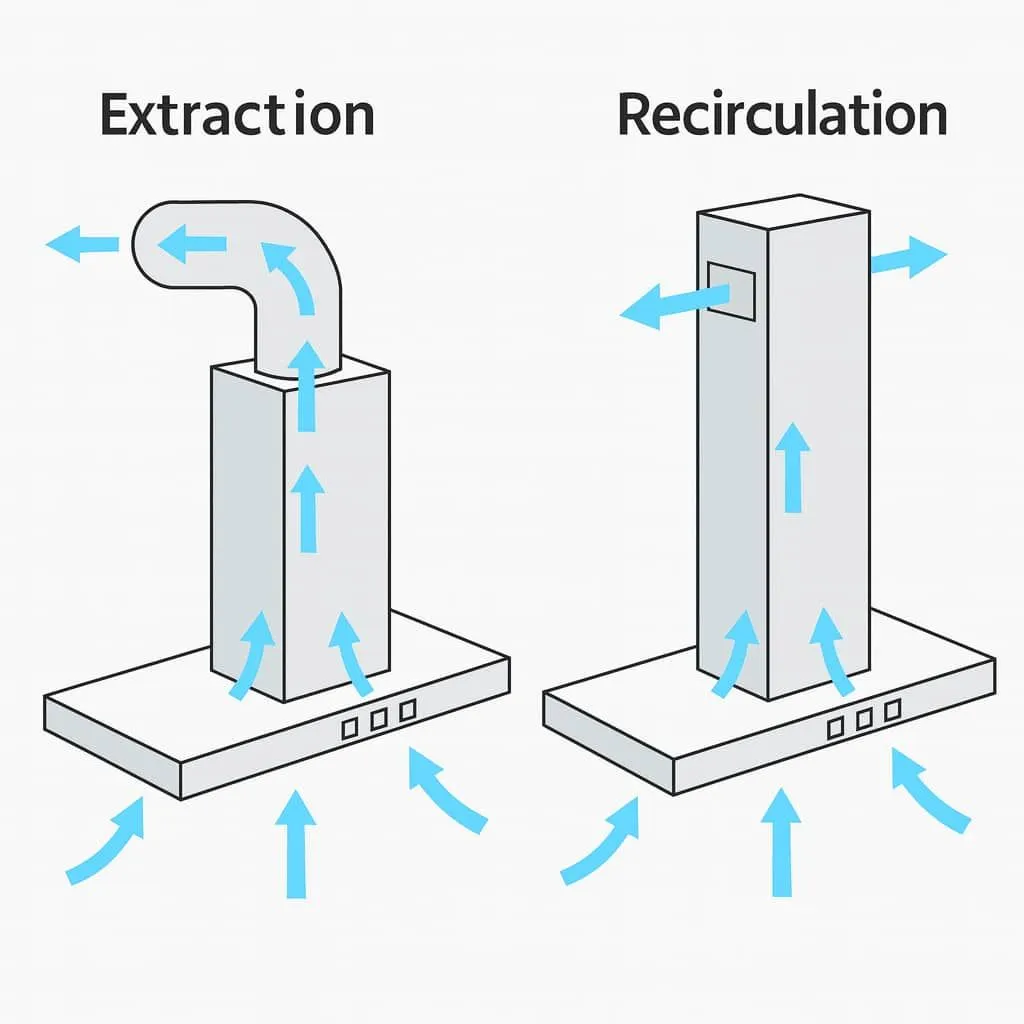
Ducted or recirculating: the quick answer
- Ducted extraction sends cooking vapour, odours and airborne contaminants outside.
- Recirculation filters the air and returns it to the kitchen.
- Ducted extraction is generally the most effective option where a suitable external route is available.
- Recirculation is ideal where external ducting is difficult or impossible.
- Recirculating hoods require carbon filters as well as grease filters.
- Recirculation removes odours and grease, but it does not remove moisture from the room in the same way as ducting outside.
What is a ducted cooker hood?
A ducted cooker hood draws air away from the hob, passes it through the grease filters and then sends it outside through a duct.
Because the extracted air leaves the building, steam, moisture, cooking smells and airborne grease are physically removed from the kitchen.
This is usually the preferred setup when a suitable route to an outside wall or roof is available.
What is a recirculating cooker hood?
A recirculating cooker hood does not send the extracted air outside. Instead, the hood draws cooking air through its filters before releasing it back into the room.
The metal grease filters capture grease particles, while an additional carbon or charcoal filter helps absorb cooking odours.
This makes recirculation particularly useful in kitchens where installing a duct to an outside wall is difficult, such as apartments, internal kitchens or certain kitchen islands.
The main difference is moisture. A carbon filter can help remove smells, but the filtered air is still returned to the room. Steam and humidity therefore remain inside the kitchen and need to be dealt with through normal room ventilation.
Ducted vs recirculating cooker hoods
| Feature | Ducted | Recirculating |
|---|---|---|
| Cooking smells | Removed outside | Reduced using carbon filters |
| Grease | Captured by grease filters | Captured by grease filters |
| Steam and moisture | Removed outside | Returned to the room |
| External duct required | Yes | No external vent required |
| Carbon filter required | Usually no | Yes |
| Installation | Requires a suitable duct route | Usually easier where external ducting is not possible |
| Ongoing maintenance | Clean grease filters | Clean grease filters and replace carbon filters |
Advantages and disadvantages
Ducted extraction
- Removes cooking air from the kitchen completely.
- Removes steam and humidity as well as smells.
- No regular carbon filter replacement in most installations.
- Usually provides the best overall extraction performance.
- Requires a suitable route to the outside.
- Poorly designed ducting can reduce performance and increase noise.
Recirculation
- No external wall or roof outlet is required.
- Useful for flats, apartments and difficult kitchen layouts.
- Can give greater freedom when positioning a hob or kitchen island.
- Carbon filters help reduce cooking smells.
- Carbon filters need periodic replacement.
- Moisture remains in the kitchen.
Which option gives better extraction?
Where installation allows it, ducting outside is normally the most effective method because the contaminated air is removed from the kitchen altogether.
With recirculation, the hood still captures grease and filters odours, but the air itself remains inside the property.
That does not mean recirculation is ineffective. A good quality cooker hood with suitable carbon filters can work very well, particularly where external extraction simply is not practical.
Does duct size matter?
Yes. The ducting should be at least the size recommended for the cooker hood. Reducing the outlet to a significantly smaller duct can restrict the airflow and make the hood work less effectively.
Many high-performance ViandPro cooker hoods use a 150 mm round outlet or an equivalent rectangular duct, although you should always check the installation instructions for the exact model.
For the best airflow, keep ducting as short and straight as possible and minimise unnecessary bends.
You can read more about improving the installation in our guide to reducing cooker hood noise.
Is recirculation easier to install?
Usually, yes. The major advantage of recirculation is that you do not need to create an external wall or roof outlet.
However, this does not always mean that no ducting is required at all.
Some cooker hoods simply return filtered air through vents built into the hood itself. Other designs, particularly flush-fit ceiling hoods, may require a short internal duct run to direct the filtered air back into the kitchen through a separate vent.
For example, ViandPro Aria and Opus ceiling hoods can be configured for recirculation using a dedicated filter and ducting kit, allowing the filtered air to be returned discreetly into the room. :contentReference[oaicite:1]{index=1}
How often do recirculation filters need replacing?
Metal grease filters are generally reusable and should be cleaned regularly in accordance with the cooker hood instructions.
Carbon filters are different. They absorb cooking odours and gradually become saturated, so they need to be replaced periodically.
The replacement interval depends on the hood, filter type and how often you cook. Always follow the instructions supplied with your particular model.
For example, the current ViandPro Aria and Opus recirculation kit recommends replacing its charcoal filter approximately every 4 to 6 months. :contentReference[oaicite:2]{index=2}
What is best for an island hob?
Kitchen islands are often where recirculation becomes especially useful.
Ducting an island hood outside may require a route through the ceiling, floor void or roof. If this cannot be achieved neatly, choosing a cooker hood designed for recirculation may substantially simplify the installation.
The same applies to downdraft extractors and venting hobs, where filtered air can often be returned through the kitchen plinth rather than ducted to an external wall.
What is best for a ceiling cooker hood?
If an external duct route is available, ducted extraction remains an excellent choice for a ceiling hood.
However, recirculation can solve one of the biggest challenges with ceiling extraction: reaching an outside wall without creating a large bulkhead or complicated duct run.
The ViandPro Aria, for example, is designed to fit between standard joists and can be installed as either a ducted or recirculating ceiling hood. :contentReference[oaicite:3]{index=3}
Which should I choose?
Choose ducted extraction if you have a sensible route to an outside wall or roof and want to remove steam, moisture and cooking odours from the kitchen as efficiently as possible.
Choose recirculation if external ducting would be difficult, expensive or impossible, or if your kitchen layout requires greater flexibility.
The best choice is ultimately the one that works properly with the building. A well-installed recirculating hood is preferable to a ducted hood connected to a long, narrow and heavily restricted duct run.
Frequently asked questions
Is a ducted cooker hood better than recirculation?
Ducting outside is generally more effective because the extracted air, steam and moisture are removed from the kitchen. Recirculation is a very useful alternative where external ducting is not practical.
Can every cooker hood be used for recirculation?
No. The hood must be designed to support recirculation and the correct carbon filters or recirculation kit must be available for that model. Always check the product specification before purchasing.
Does a recirculating cooker hood remove steam?
It captures grease and helps reduce cooking odours, but it does not exhaust humid air outside. Moisture from cooking therefore remains within the room.
Do I need a carbon filter when ducting outside?
Usually not. Carbon filters are primarily used when the cleaned air is being recirculated back into the kitchen. The standard metal grease filters are still used in both configurations.
Can a ceiling hood be recirculating?
Yes, provided the model is specifically designed for it. Some ceiling hoods use a short internal duct run to return filtered air to the room through a discreet ceiling vent.
Is recirculation noisier than ducting?
Not necessarily. Noise depends on the hood, fan speed, filters and installation. A poor external duct route can make a ducted hood noisy, while filter resistance and airflow can also affect a recirculating installation.
Find the right cooker hood for your kitchen
Explore ViandPro wall, ceiling, island and downdraft cooker hoods, with ducted and recirculating options available across the range.
Shop cooker hoods